
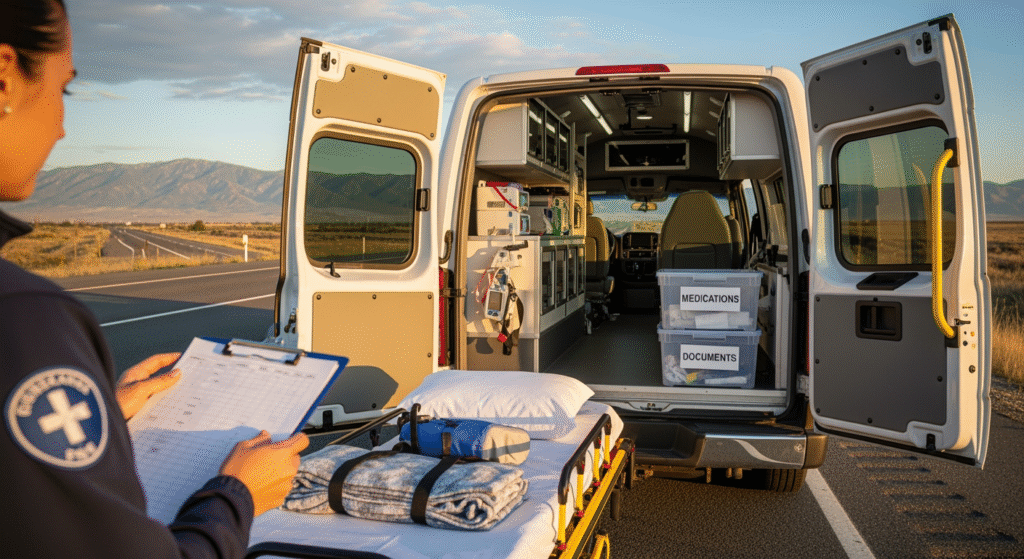
Planning a non-emergency move for a loved one can feel overwhelming—especially when the trip is long, the patient has complex needs, and multiple facilities or family members are involved. This long-distance medical transport checklist is built for family caregivers, guardians, and care partners who need a practical way to organize documents, medications, and comfort items before a trip over 300 miles. A clear checklist matters because small gaps (missing paperwork, unclear medication times, or overlooked hygiene supplies) can create avoidable stress during handoffs and along the route. The goal is simple: help you prepare in a way that supports continuity of the patient’s existing care plan, reduces last-minute scrambling, and keeps everyone aligned on what will happen during transport. For a broader overview of how these trips typically work, see Understanding Long-Distance Medical Patient Transport.
Quick Answer
- ✓ Gather essential paperwork: ID, insurance cards, facility discharge documents, and a current medication list.
- ✓ Pack medications in original containers with a written schedule that matches the patient’s existing care plan.
- ✓ Prepare comfort items for long hours: bedding preferences, hearing/vision aids, and simple calming items.
- ✓ Confirm mobility and care needs: oxygen requirements, incontinence supplies, and repositioning/turning routines.
- ✓ Plan communication: designate one point of contact, share updates expectations, and keep key phone numbers handy.
What this means
A long-distance, non-emergency medical patient trip is primarily a logistics and continuity task: you’re coordinating the person’s existing care plan, personal needs, and administrative requirements over many hours and across jurisdictions. Your preparation should focus on (1) proving identity and authorization, (2) ensuring the patient’s prescribed routines can be followed without improvising, and (3) keeping the patient as comfortable and calm as possible. This is not the time to introduce new treatments or change medication instructions—your role is to organize what’s already prescribed and make it easy to follow during travel.

Why it matters
Long trips magnify small problems. Missing documents can delay a discharge or create confusion at the receiving facility. Unclear medication timing can lead to missed doses or stressful phone calls. Inadequate comfort supplies can increase agitation, fatigue, or discomfort—especially for patients with cognitive impairment or those who are bed-bound. Preparation also affects cost and timing indirectly: when everyone has the same plan and the right items are ready, transitions tend to be smoother and less prone to last-minute changes.
Common mistakes to avoid (Checklist)
- ✓ Bringing loose pills without labels (High priority). Keep medications in original, labeled containers to reduce confusion and support accurate administration per the existing schedule.
- ✓ Packing paperwork in multiple places (High priority). Use one folder or envelope so ID, authorizations, and discharge paperwork are immediately accessible.
- ✓ Relying on memory for medication times (High priority). Write a simple schedule (times + dose + special notes) that matches the current care plan.
- ✓ Forgetting “small” assistive items (Medium priority). Glasses, hearing aids, dentures, and chargers are easy to overlook but can significantly affect comfort and communication.
- ✓ Underpacking incontinence and hygiene supplies (Medium priority). Long trips can require more changes than expected; pack extra to avoid running short.
- ✓ Not clarifying who will receive the patient (High priority). Confirm the receiving facility or family member, arrival window expectations, and after-hours procedures.
- ✓ Assuming rideshare-style transport is comparable (High priority). Non-emergency medical patient transportation is scheduled and care-plan-oriented; it is not an on-demand “medical Uber” model.
Best practices / Preparation checklist (Checklist)
- ✓ Create a single “Transport Packet” (High priority). Include: photo ID, insurance cards (if applicable), advance directives (if applicable), POA/guardian documents (if applicable), discharge summary, and receiving facility contact details.
- ✓ Print a current medication list (High priority). List medication name, dose, route, and scheduled times. Add allergies and sensitivities on the same page.
- ✓ Pack medications for more than the travel window (High priority). Bring enough for the trip plus a buffer in case of delays, while keeping everything labeled and organized.
- ✓ Prepare a “Care Routine Notes” sheet (High priority). Include turning/repositioning timing, feeding routines (if applicable), swallow precautions, preferred comfort measures, and typical triggers for anxiety or agitation.
- ✓ Confirm oxygen needs and supplies (High priority). Document prescribed oxygen flow requirements and any equipment the patient uses as part of their existing plan.
- ✓ Pack an incontinence and skin-care kit (High priority). Include briefs, wipes, barrier cream, disposable pads, gloves, and extra linens as appropriate.
- ✓ Include comfort and orientation items (Medium priority). Blanket, pillow, familiar music, a small photo, or a simple fidget item can help—especially for dementia or cognitive impairment.
- ✓ Prepare clothing and warmth layers (Medium priority). Choose easy-on/off items and include socks and a light jacket or shawl for temperature swings.
- ✓ Bring assistive devices and backups (Medium priority). Glasses, hearing aids, denture case, batteries, chargers, and labeled storage containers.
- ✓ Keep a contact list accessible (High priority). Primary caregiver, prescribing provider office (for records questions), sending facility unit, receiving facility nurse’s station, and pharmacy phone number.
- ✓ Decide who is the single point of contact (High priority). One person should field calls and coordinate updates to reduce confusion among family members.
- ✓ Plan the arrival handoff (High priority). Confirm where the patient will be received, what documents the receiving team expects, and who will sign/accept.

Pro Tip from the Field
In practice, we often see the smoothest long-distance trips when caregivers prepare two clearly labeled kits: one “Do Not Pack Away” folder for documents and schedules, and one “Reachable During Travel” bag for the next 8–12 hours of essentials (meds, wipes, briefs, chargers, hearing/vision items). Keeping those separate reduces mid-trip searching and helps everyone stay on the same plan.
When to consider professional help
- ✓ The patient cannot sit upright for extended periods. A stretcher-based, non-emergency medical patient option may be more appropriate for comfort and safety.
- ✓ The care plan includes timed routines that must be maintained. If medication, feeding, oxygen, or repositioning schedules are critical, you’ll want a transport model designed around continuity rather than convenience.
- ✓ The patient has dementia or significant cognitive impairment. Longer trips can be disorienting; structured support and predictable routines can reduce stress for patient and family.
- ✓ The trip crosses state or national borders. Multi-jurisdiction travel adds complexity in documentation, receiving coordination, and timing.
- ✓ You’re unsure whether the situation is non-emergency. If symptoms suggest an emergency, seek emergency services; non-emergency transport is not a substitute for 911/EMS.
FAQs
What paperwork should I keep immediately accessible during a multi-hour patient trip?
Keep a single folder with photo ID, any authorization/guardian documents (if applicable), discharge paperwork, a current medication list, allergy information, and the receiving facility’s contact details.
How should medications be packed for a long ride?
Bring medications in original, labeled containers and include a written schedule that reflects the patient’s existing prescribed routine. Avoid unlabeled pill organizers unless the labels and instructions are clearly documented.
What comfort items tend to matter most on extended stretcher travel?
Commonly helpful items include a familiar blanket, pillow preferences if allowed, hearing/vision aids with chargers, denture supplies, and simple calming items such as music or a small photo.
Is non-emergency medical patient transportation the same as a rideshare or on-demand driver?
No. Rideshare models are typically designed for general travel. Non-emergency medical patient transportation is scheduled and organized to support mobility limitations and continuity of an existing care plan during the trip.
How do I know if the situation is not appropriate for non-emergency transport?
If the patient appears to have a medical emergency or needs urgent evaluation, call emergency services. Non-emergency transport is intended for stable situations where the goal is relocation or transfer while maintaining an existing care plan.
Summary & Next Step
This checklist is designed to help you organize the essentials—paperwork, medication routines, and comfort supplies—so a long trip is calmer and more predictable. Focus on continuity: clear documentation, labeled medications with a written schedule, and practical kits that are easy to access during travel. Confirm handoff details early, and keep communication simple by choosing one point of contact. When the patient’s needs are complex, planning ahead reduces stress for everyone involved.