
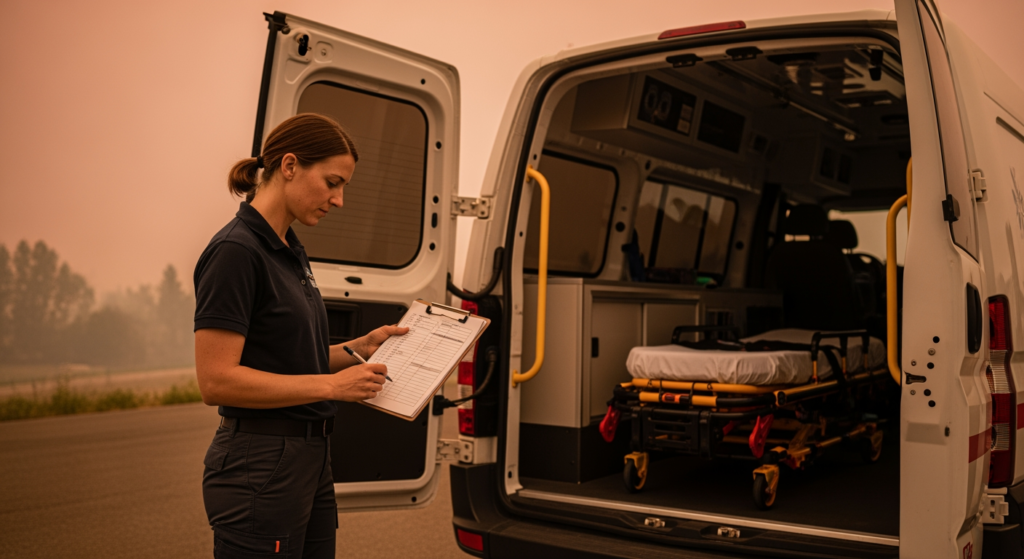
Wildfire smoke can complicate a long trip—especially when you’re coordinating non-emergency medical patient transportation for someone who’s medically fragile, uses oxygen, or struggles with fatigue. If you’re a family member, caregiver, or discharge planner trying to move a patient safely and comfortably, the big questions are usually practical: How do you plan around air quality? What information should you share? And what can a non-emergency transport team realistically do (and not do) during the trip? Summer travel schedules can also make coordination trickier, so having a simple checklist and clear expectations helps.
This FAQ focuses on logistics and planning for Understanding Long-Distance Medical Patient Transport when smoke conditions are a concern—without drifting into medical advice.
Bottom Line Upfront for Wildfire Smoke Transport
- Confirm the trip is non-emergency; if the patient is unstable or needs new medical intervention, a different level of care may be required.
- Share the patient’s existing care plan (oxygen orders, medication schedule, dietary needs, repositioning schedule) so it can be maintained during the trip.
- Plan for route and timing flexibility in case conditions change, including extra buffer for stops and slower travel.
- Ask how the transport team handles comfort and exposure reduction inside the vehicle (for example, keeping windows closed and managing cabin comfort).
- Keep a single point of contact for updates so family and facilities aren’t playing phone tag during a long day of travel.
How Smoke Conditions Change Long-Distance Medical Travel
Smoke-related travel planning is less about “toughing it out” and more about reducing avoidable stressors during a long-distance, non-emergency medical patient transport. For many families, the challenge is that smoke conditions can shift quickly, and the patient may already be dealing with limited mobility, fatigue, cognitive impairment, or oxygen requirements.
From a logistics standpoint, the most useful approach is to treat smoke as a planning variable: you may need extra time, a more flexible route, and clearer communication between the sending facility, receiving facility, and the family member coordinating the move. The goal is continuity—maintaining the patient’s existing prescribed routines (medications, hydration, feeding schedules, comfort measures) while keeping the trip as steady and comfortable as possible.
How Wildfire Smoke Can Affect Your Timeline, Comfort, and Coordination
Even when a patient is stable and the trip is non-emergency, smoke conditions can create real-world friction that families feel immediately.
- Scheduling becomes less predictable: You may need to build in buffer time for slower driving, additional rest stops, or route changes.
- Facility coordination can take longer: Sending and receiving facilities may have tighter intake windows or added screening steps, which can affect pickup and drop-off timing.
- Comfort needs may increase: Patients who are sensitive to odors or prone to nausea can have a harder time on long trips when outside conditions are unpleasant.
- Family stress goes up: When conditions change mid-trip, families often worry about “what happens next,” so clear update routines matter.
Common Mistakes to Avoid When Planning a Smoke-Affected Trip
- Assuming it’s “just a normal ride”: Long-distance medical patient transportation is planned care continuity—not a standard car trip—so details matter.
- Not sharing the current care routine in writing: Verbal handoffs get messy during busy discharges; written schedules reduce confusion.
- Forgetting comfort essentials: Items like approved snacks (if allowed), comfort blankets, and hearing/vision aids can prevent avoidable distress.
- Overpacking last-minute and losing key documents: Keep IDs, facility paperwork, and medication lists together in one folder.
- Waiting too long to confirm logistics: If smoke is a concern, earlier coordination helps you avoid rushed decisions.
A Practical Pre-Trip Checklist for Smoke-Aware Medical Travel
- Confirm non-emergency status: Verify the patient is stable for a planned, non-emergency move.
- Provide the existing care plan: Share medication times, oxygen requirements, feeding routines, hydration preferences, and repositioning schedule.
- Clarify mobility needs: Note whether the patient is non-ambulatory, needs a stretcher, and what transfer assistance is required.
- Align facility handoffs: Confirm pickup location, paperwork requirements, and receiving facility intake expectations.
- Set an update plan: Choose one family contact for real-time updates and confirm how communication will happen during the trip.
- Pack a “comfort + continuity” kit: Approved personal items, spare clothing/incontinence supplies as needed, and any assistive devices the patient uses daily.
Professional Insight: What Most Families Miss About Smoke-Season Planning
In practice, we often see that the smoothest trips happen when families focus less on trying to predict every smoke change and more on making the patient’s routine easy to follow during travel—clear schedules, clear paperwork, and one decision-maker for communication.
When It’s Time to Involve a Professional Transport Team
Consider getting help coordinating long-distance, non-emergency medical patient transportation if any of the following are true:
- The patient is non-ambulatory and needs stretcher transport for a trip over 300 miles.
- The patient requires oxygen or other prescribed support that must be maintained consistently during travel.
- The patient has dementia or cognitive impairment and may become disoriented during a long day of transitions.
- The patient needs scheduled turning/repositioning or incontinence care during the trip.
- You’re coordinating between multiple facilities and need a predictable handoff plan and reliable updates.
Your Questions, Answered
Can a non-emergency medical transport still run when air quality is poor?
Sometimes, yes—if the patient is stable for non-emergency travel and the trip can be planned responsibly. The key is coordinating around the patient’s existing care plan and confirming the transport team’s approach to comfort, communication, and timing flexibility.
What information should I share before a smoke-affected long trip?
Share the patient’s current prescribed routines and needs: medication schedule, oxygen requirements (if applicable), feeding/hydration routines, mobility limitations, repositioning schedule, and any cognitive or behavioral considerations that affect comfort and cooperation.
Is this the same as a medical rideshare or on-demand service?
No. Long-distance, non-emergency medical patient transportation is planned and structured around the patient’s mobility needs and continuity of an existing care plan. It’s not an on-demand rideshare model.
Does Managed Medical Transport, Inc. provide medical treatment during the trip?
No. Managed Medical Transport, Inc. does not provide diagnosis or medical treatment and does not initiate new care plans. For non-emergency transports, the focus is on maintaining the patient’s existing prescribed care plan during travel.
How do I know if the situation is non-emergency?
If the patient is unstable, deteriorating, or needs urgent evaluation, that’s not a non-emergency transport scenario. For planned travel, it’s typically appropriate when the patient is stable and the goal is a coordinated transition between care settings while maintaining existing routines.
Moving Forward
Smoke conditions can add uncertainty to an already emotional move, but good planning keeps the trip grounded in what matters: stability, comfort, and continuity. Start by confirming the patient is appropriate for non-emergency travel, then document the care routine and align expectations with the facilities involved. If you need help coordinating a long-distance move, a professional team can reduce the logistical load on your family.
Get in Touch
Fill out our quick form and we’ll get back to you within 24 hours.