

Families often ask whether a loved one can travel lying down for a long trip—especially after a hospital stay, during rehab transitions, or when sitting upright is uncomfortable. This how-to guide is for caregivers, discharge planners, and family decision-makers who need a safe, practical plan for arranging non-emergency transportation that supports comfort and continuity of care without turning the trip into a medical event. As fall schedules ramp back up, coordinating a move between facilities (or back home) can feel like solving a puzzle with half the pieces missing. The goal is simple: confirm the patient’s eligibility for a lying-down ride, gather the right paperwork, and set expectations so the day-of transport runs smoothly.
Before you start, it helps to understand how non-urgent medical travel differs from on-demand rides and what “stretcher transport” typically includes. For a plain-language overview, see Understanding Non-Emergency Medical Transportation.
The Essentials for Lying-Down Travel
- Yes, lying-down travel is often possible in a stretcher-equipped, non-urgent medical patient transport designed for comfort and monitoring—not treatment.
- Start with the patient’s current care plan: the trip should maintain existing routines (medications, oxygen, feeding schedule) rather than create new ones.
- Confirm mobility needs early (non-ambulatory, needs assistance with transfers, repositioning schedule) so the right vehicle setup is arranged.
- Plan for time and fatigue: long trips require realistic breaks, hydration/meal planning, and comfort measures.
- Prepare documentation (discharge notes, medication list, IDs, facility contacts) to avoid last-minute delays.
How Lying-Down Non-Emergency Transportation Works in Real Life
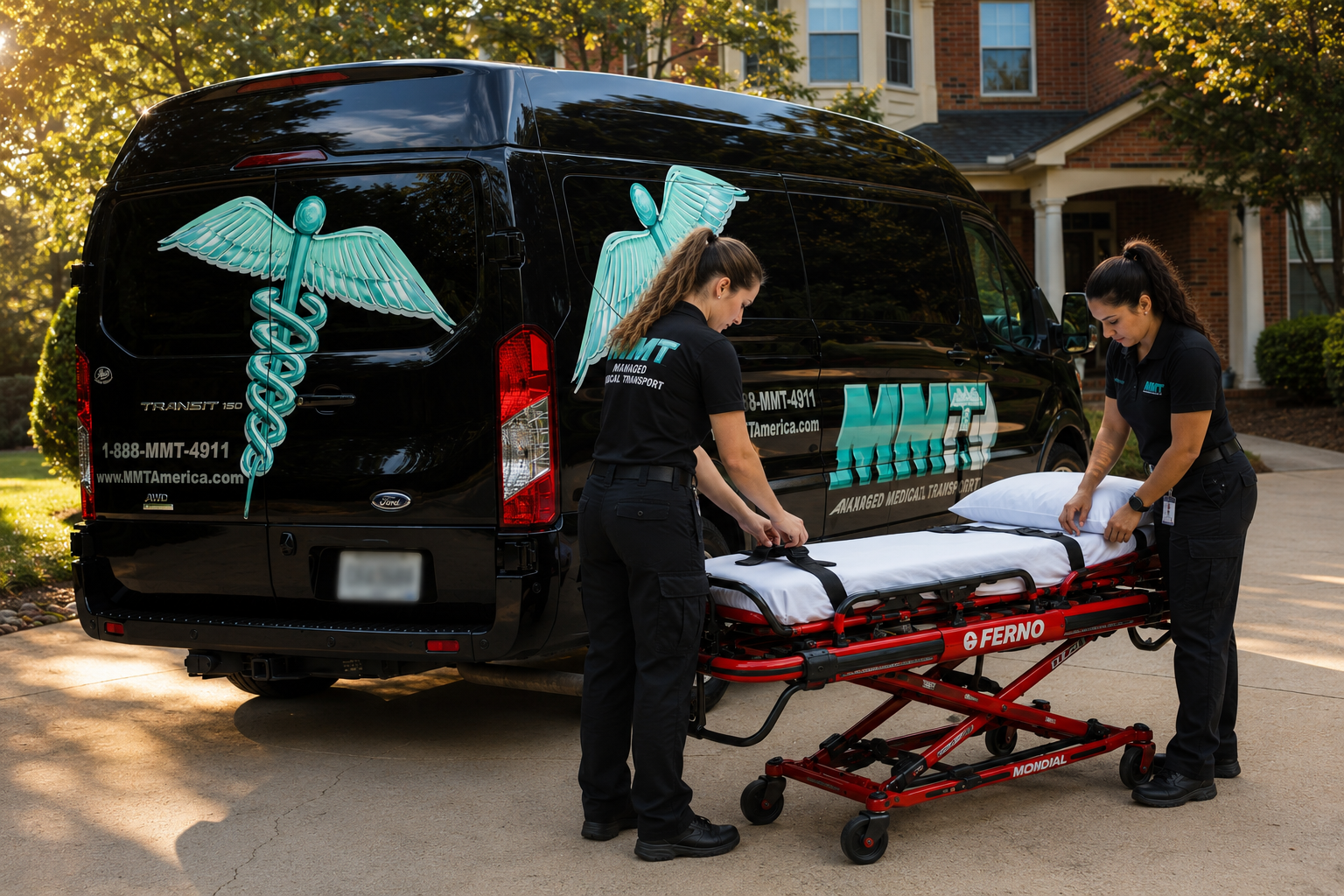
Lying-down travel usually means the patient rides on a stretcher in a vehicle configured for non-emergency medical patient transportation. The transport team’s role is logistical and supportive: helping the patient travel safely and comfortably while maintaining an existing prescribed care plan (for example, medication timing, oxygen use, or feeding routines). This is not emergency care, and it’s not a replacement for clinical decision-making.
In practice, the process goes more smoothly when everyone agrees on three things upfront:
- Why the patient must ride lying down (comfort, tolerance, mobility limits).
- What care needs must be maintained during the trip (no new interventions).
- Who is responsible for what (sending facility, receiving facility, family, and transport provider).
The Real-World Impact: Comfort, Timing, and Coordination
Choosing a lying-down option affects more than posture—it changes the entire travel plan. Expect more coordination time than a standard car ride because transfers, facility handoffs, and patient comfort steps take longer.
- Time: Loading/unloading and safe transfers can extend the schedule. Build in buffer time for facility paperwork and patient fatigue.
- Cost structure: Stretcher-capable, long-distance non-emergency medical transport is typically priced differently than rideshare or wheelchair vans because of staffing, equipment, and trip length.
- Safety and comfort: A stable lying-down position can reduce discomfort for patients who cannot sit for extended periods, but it still requires planning for repositioning, restroom/incontinence needs, and hydration.
- Continuity of care: Clear handoff information helps reduce disruptions to the patient’s routine during travel.
Common Missteps That Derail Lying-Down Travel (Checklist)
- Assuming any “medical ride” can do stretcher trips — many services are not equipped for non-ambulatory, lying-down transport.
- Not confirming the trip is non-emergency — if the patient is unstable or needs urgent intervention capability, you need a different level of service than non-urgent transport.
- Missing the medication schedule — families sometimes pack meds but don’t provide a clear timing plan aligned to the current care orders.
- Forgetting oxygen logistics — bring clarity on whether oxygen is required, the flow rate as ordered, and how it will be supplied during the ride.
- No plan for toileting/incontinence care — long trips require realistic arrangements and supplies, not wishful thinking.
- Unclear facility contacts — lack of a direct receiving contact can cause arrival delays and stressful handoffs.
A Step-by-Step Plan to Arrange Lying-Down Travel
- Prerequisite: Confirm the patient is appropriate for non-urgent travel.
Tip: Ask the sending clinician to document that the patient is stable for non-emergency transport and can travel while maintaining the current care plan (no escalation expected en route). If the clinician is unsure, ask what level of transport they recommend and why. - Step 1: Define the mobility requirement in one sentence.
Tip: Use clear language such as “non-ambulatory and needs stretcher transport” or “cannot tolerate sitting upright for extended periods.” Add any specifics that affect safety: “requires two-person assist for transfers,” “needs repositioning every X hours,” or “has fracture precautions.” - Step 2: Collect a travel-ready care summary.
Tip: Prepare a simple packet: medication list with exact administration times, allergies, oxygen requirement (device and ordered flow rate), feeding instructions (including tube feeds if applicable), swallow precautions/diet consistency, skin precautions, and repositioning needs. Include the most recent discharge/transfer note if available. - Step 3: Map the handoffs (send/receive) before booking.
Tip: Write down names and direct phone numbers for the sending unit/facility and the receiving unit/facility. Confirm the scope of the handoff: bedside-to-bedside vs. curb-to-curb, and exactly where the patient will be received (front desk vs. admissions vs. nurse’s station). - Step 4: Ask action-oriented questions before you schedule.
Tip: Use these prompts so responsibilities are clear:- Staffing: “How many staff will be on the trip, and can they perform the transfers required (e.g., two-person assist)?”
- Oxygen: “Who supplies oxygen during transport—the facility, the family, or the transport provider—and what documentation do you need for the ordered flow rate?”
- Repositioning: “Can you accommodate repositioning on the schedule ordered (e.g., every 2 hours), and what should we provide (pillows, wedges, briefs)?”
- Ride-along policy: “Can a family member accompany the patient, and if so, are there limits on seating or luggage?”
- Bedside-to-bedside: “Do you pick up from the patient’s room and deliver to the receiving room, and what are the facility requirements for entry/arrival?”
- Step 5: Plan comfort and tolerance supports for a long ride.
Tip: Pack comfort items that don’t interfere with safety: a light blanket, familiar pillow, hearing aids/glasses, and approved snacks consistent with diet instructions. If the patient has cognitive impairment, bring calming items (music, a familiar object) and confirm any redirection strategies the facility uses. - Step 6: Create a “day-of” checklist and keep it with one person.
Tip: Assign a single coordinator (family member or case manager) to hold IDs, paperwork, medication timing notes, and facility contacts. Include a written “arrival plan” (who meets the vehicle, where the patient goes, and who signs/receives paperwork). - Step 7: Confirm communication expectations.
Tip: Decide who receives updates during transport and who is the point of contact at the receiving facility. Ask what triggers an update (departure, scheduled check-ins, delays, arrival).
What We’ve Learned About Smooth Lying-Down Trips
General planning guidance (not a guarantee): Lying-down trips tend to be easier to coordinate when families and facilities treat the transport like a structured handoff. That means the patient’s routine (meds, oxygen orders, diet/swallow precautions, repositioning schedule) is written down in a travel-ready format, and the receiving facility knows the estimated arrival window and exactly who will accept the patient.

When to Ask for Professional Support Instead of DIY
Seek professional help arranging a lying-down option if any of the following are true:
- The patient is non-ambulatory and cannot transfer safely with family assistance alone.
- The patient cannot tolerate sitting for the expected duration of travel.
- Oxygen, feeding routines, or scheduled repositioning must be maintained during the trip.
- Cognitive impairment is significant (for example, dementia-related agitation) and a structured, calm environment is needed.
- The trip is long-distance and requires coordinated handoffs between facilities.
Your Questions, Answered
Is riding on a stretcher the same as emergency care?
No. A stretcher can be used for non-urgent medical patient transportation focused on safe travel and comfort. It is not emergency response and does not replace hospital-level care.
What information should I have ready before I call a transport provider?
Have the pickup/drop-off details, the patient’s mobility status, a current medication schedule with exact times, any oxygen/feeding needs (including ordered flow rate and device), diet or swallow precautions (if applicable), repositioning requirements, and direct facility contacts. Also ask whether the service is bedside-to-bedside and whether a family member can ride along.
Can a family member ride along?
Some long-distance non-emergency providers allow one family member to accompany the patient. Confirm this during scheduling so seating and logistics are clear.
How do I know if a patient is stable enough for a long trip?
The sending clinician or facility care team should confirm whether the patient is appropriate for non-urgent travel based on the current care plan and condition stability.
Where to Go from Here
Lying-down travel can be a practical option when sitting isn’t realistic and the patient’s current care plan can be maintained during a non-urgent trip. The safest path is to define mobility needs clearly, organize care-plan details, and coordinate both facilities before the travel day.
Ambulance vs. long-distance non-emergency stretcher transport (how to choose):
- Ambulance services function as mobile emergency rooms designed for speed, critical care, and urgent response. They are typically not designed for comfort on long trips, and many ambulance services are not licensed to cross state lines because they focus on local or regional jurisdictions.
- Long-distance non-emergency medical transport is intended for stable patients who need help traveling (including lying down) while maintaining an existing care plan—without emergency interventions.
Not appropriate for non-emergency stretcher transport if… (confirm with the sending clinician):
- The patient has unstable vital signs or is at risk of rapid deterioration.
- The patient may require continuous acute interventions (for example, IV titration, frequent medication changes based on monitoring, or other hospital-level management).
- The patient needs emergency response capability to manage likely complications during travel.
If you want help thinking through the logistics and what questions to ask, Managed Medical Transport, Inc. can walk you through the planning process. Per the company’s published FAQs, Managed Medical Transport is insured to cross state lines with an unlimited travel radius throughout the United States and Canada, and it specializes in long-distance, cross-country trips with a 300-mile minimum (if your trip is slightly under that, it may still be worth requesting a quote).
Book Your Consultation
Schedule a free consultation with a coordinator.