
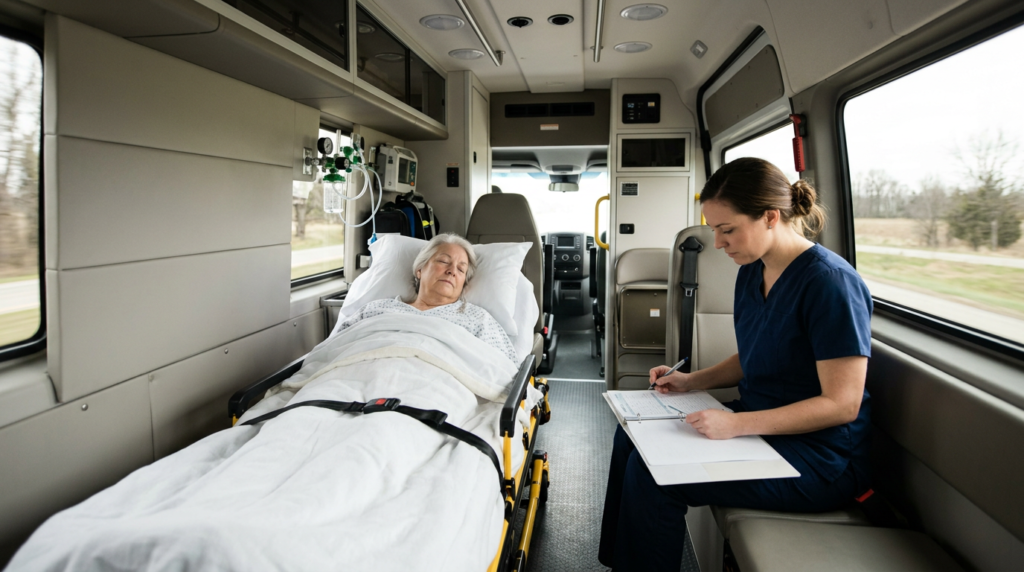
Yes. Managed Medical Transport, Inc. provides forward-facing stretcher accommodations for patients whose individually assessed needs fit its long-distance, non-emergency ground transportation service.
We specializes in state-to-state and cross-country patient journeys. For families arranging an extended trip, the first step is to discuss the patient’s positioning, mobility, and assistance needs so the proposed transport can be reviewed.
Is Stretcher Transportation Appropriate for Every Patient?
No. A diagnosis or difficulty sitting does not automatically establish eligibility.
Managed Medical Transport reviews the patient’s established needs, requested assistance, and transportation arrangements individually. If the patient is leaving a hospital or facility, the discharge team can provide information about their travel and positioning requirements. Managed Medical Transport then assesses whether those needs fit its service capabilities.
Its usual minimum is 300 miles, although exceptions may be considered individually. This service focuses on long-distance journeys rather than routine local appointment rides.
What Makes the Stretcher Accommodations Different?
Managed Medical Transport uses forward-facing stretcher accommodations and enhanced bedding, including a 4-inch memory foam overlay over the standard stretcher mattress.
These features reflect the company’s emphasis on comfort during extended travel. Families can discuss positioning requirements and any requested repositioning assistance before the trip is confirmed.
Specializing since 1997, Managed Medical Transport operates company-owned vehicles with direct employees. All crew members have hands-on patient-care backgrounds. Transportation is not assigned to subcontractors or third-party crews.
Will the Patient Need to Stay Overnight in a Hotel?
Managed Medical Transport’s straight-through transportation model means patients are not required to spend nights in hotels during multi-day journeys, including cross-country trips.
Straight-through does not mean nonstop. Necessary travel, meal, and patient-comfort stops remain part of the plan.
What Assistance Can Be Arranged?
Medically trained personnel provide patient supervision and comfort assistance within the arrangements confirmed for the individual transport.
Discuss established needs such as incontinence care, repositioning, prescribed oxygen equipment, feeding-tube routines, or diabetes-related assistance before booking. Each request must be reviewed individually; the company does not promise to carry out every element of a clinical care plan.
Managed Medical Transport may assist the patient with their already prescribed medications.
Patient supervision is distinct from continuous clinical monitoring. The company does not initiate new medications, treatments, or medical orders and does not operate as an ambulance service.
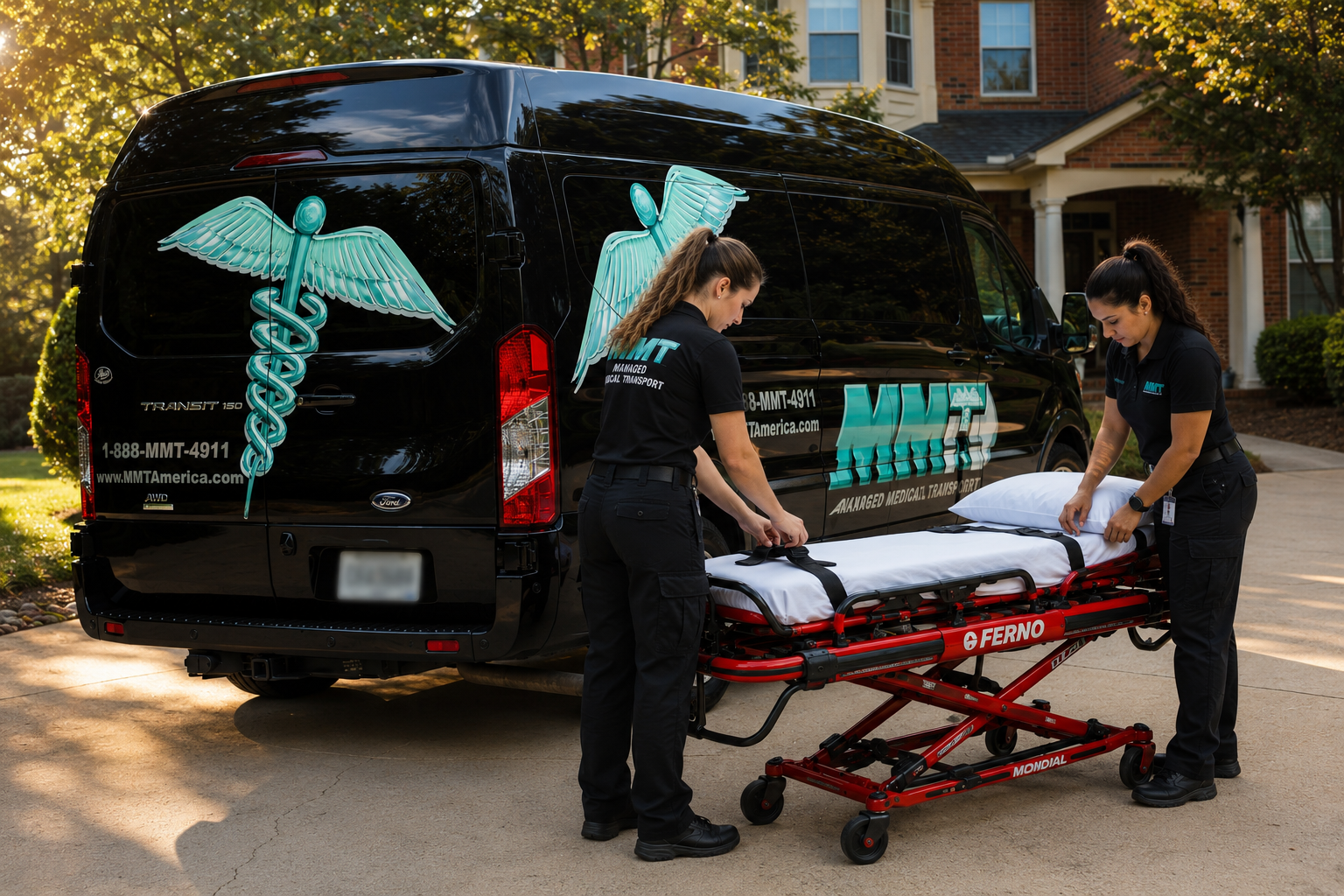
Why Getting the Details Right Affects Comfort, Timing, and Cost
Small planning gaps can turn into major friction during a long-distance stretcher trip. If the pickup location can’t accommodate a stretcher, if the destination requires special entry coordination, or if the patient’s needs weren’t communicated clearly, the day-of plan may need to change—affecting timing and potentially requiring a revised quote.
Long-distance trips are usually quoted based on the actual pickup city, destination city, patient needs, and transport circumstances. If the route, schedule, stops, or assistance needs change after booking, it’s reasonable to expect the transport plan (and pricing) may need to be updated to match what’s actually required.
Common Missteps to Avoid Before a Lying-Down Transport (Checklist)
- Assuming “non-emergency” means “no planning” — long-distance stretcher trips require coordination with facilities, family, and timing windows.
- Waiting to mention oxygen, feeding tubes, or repositioning needs — these must be discussed in advance and confirmed case by case.
- Not confirming pickup/destination access — stairs, narrow hallways, and facility rules can affect the plan.
- Expecting a fixed travel time or flat price by state pair — trip distance, travel time, and pricing are calculated individually.
- Blurring the line between planned transport and emergency response — this service is strictly non-emergency and does not replace physicians, hospitals, or emergency services.
Your Step-by-Step Plan to Arrange Lying-Down Non-Emergency Transportation
Prerequisites (have these ready): pickup address and point-of-contact, destination address and point-of-contact, the patient’s mobility level (can they sit at all?), and a concise list of established needs that may require assistance during travel.
- Confirm it’s appropriate for a planned, non-emergency trip.
Tip: If the patient’s condition is unstable or requires emergency-level response, pause and follow the facility’s or physician’s direction for appropriate care pathways. - Describe why the patient needs to travel lying down.
Tip: Keep it practical: “cannot tolerate sitting,” “bed-bound,” “pain with upright posture,” or “requires stretcher for safe transfers.” Avoid guessing diagnoses or offering medical conclusions. - Share the patient’s established assistance needs for case-by-case review.
Tip: If the patient uses prescribed oxygen, has a feeding tube routine, needs incontinence assistance, or needs scheduled repositioning, raise it early so the provider can confirm what can be supported within the agreed transport arrangements. - Align on the travel model: straight-through vs. planned breaks.
Tip: Straight-through travel can still include routine stops. Ask how comfort breaks are handled and how the schedule is coordinated with facility discharge timing. - Confirm comfort features that matter on a long ride.
Tip: Ask about stretcher orientation (forward-facing vs. other setups), bedding options, and how the patient is positioned for comfort. - Lock in pickup details and destination “handoff” details.
Tip: Get names and direct phone numbers for the sending and receiving contacts. Clarify where the vehicle should arrive and where the patient should be delivered (room, admissions, front desk, etc.). - Ask about family ride-along and updates—based on your specific trip.
Tip: An accompanying family member is generally permitted subject to seating availability and your arrangements. Please ask about the family update and vehicle-tracking options available for your transport. - Review the quote details and what changes could trigger a revision.
Tip: Confirm what’s included for your specific transport plan (route, timing, stops). If anything changes—pickup time, destination, patient needs—ask what to do next.

From the Field: The Detail Families Most Often Miss
In practice, we often see the smoothest long-distance stretcher transports happen when the family (or discharge planner) treats the destination like an appointment: confirm who will receive the patient, where the vehicle should arrive, and what the receiving facility expects at handoff—before the vehicle is on the road.
When You Should Get Professional Help Coordinating the Trip
- The patient cannot sit safely for extended periods and a stretcher is needed for the full journey.
- The move is state-to-state or cross-country and coordinating multiple legs would create unnecessary strain.
- There are established care needs to discuss (for example, prescribed oxygen, feeding tube routines, incontinence care, or repositioning needs) that require case-by-case confirmation.
- The sending or receiving facility has strict timing windows and you need a transport plan that matches them.
- You’re unsure whether the situation is truly non-emergency and need clarity on whether planned transport is appropriate (without seeking medical advice).
Common Questions About Lying-Down Travel
Is a stretcher ride only for short trips?
No. Some providers specialize in long-distance, state-to-state ground transport using stretcher accommodations. The practical fit depends on the patient’s needs and the provider’s confirmed capabilities.
Do patients have to stay overnight in a hotel on multi-day trips?
Not always. Some long-distance ground transports are arranged as straight-through travel, meaning the patient is not required to spend nights in hotels, while still making routine travel and comfort stops.
Can a transport team help with medications during the trip?
Managed Medical Transport may assist the patient with their already prescribed medications. This is discussed as part of the planned transport arrangements and does not include diagnosing, changing prescriptions, or starting new treatments.
What information should I gather before requesting a quote?
Have the pickup and destination addresses, the best contact at each location, the patient’s mobility level, and a clear list of established needs you want reviewed for the trip.
Is this the same thing as a medical rideshare?
No. Long-distance, planned patient transport is not the same as an on-demand rideshare model. A true long-distance service is scheduled in advance and built around the patient’s stretcher and comfort requirements.
Where to Go From Here
A patient can often travel lying down in a planned, long-distance ground setting when the trip is non-emergency and the transport plan matches the patient’s established needs. Start by gathering the essentials (pickup, destination, contacts, and needs), then confirm stretcher setup, comfort options, and coordination details. The more clearly you communicate upfront, the smoother the day-of logistics tend to be. If you’re comparing options, make sure you’re looking at a provider built for long-distance moves—not a local appointment ride. Many families find the simplest next step is a quick consult with MMT to review the situation and confirm fit.
Book Your Consultation
Schedule a free consultation with our experts.
REQUEST A QUOTE