

Leaving a hospital is often the easy part—getting a patient safely to the next destination across state lines is where planning matters. If you’re a family member, caregiver, or discharge planner coordinating a long trip for someone who can’t ride in a standard car, you’re likely trying to match timing, paperwork, mobility needs, and comfort in one coordinated plan. This is where non-emergency transportation can fit: it’s designed for scheduled, non-urgent transfers while maintaining the patient’s existing prescribed care plan during travel. For a plain-language overview of what this type of service includes (and what it doesn’t), see Understanding Non-Emergency Medical Transportation.
This how-to guide walks you through the steps to coordinate cross-state discharge travel without last-minute surprises—so the patient arrives on time, stable, and as comfortable as possible.
Key Points to Know Before You Book
- Start with the discharge plan: Confirm the destination facility/home address, target discharge window, and any mobility limitations.
- Match the vehicle to the patient’s mobility needs: Stretcher vs. wheelchair vs. ambulatory support should be decided early.
- Cross-state logistics are mostly paperwork and timing: Records transfer, receiving acceptance, and a realistic departure time are the usual bottlenecks.
- Non-urgent does not mean “no planning”: Long trips require a comfort plan (positioning, bedding, stops, and caregiver coordination).
- Know what the transport team can and can’t do: These trips maintain existing prescribed routines; they do not initiate new medical interventions.
How Cross-State Hospital Discharge Transport Typically Works
Cross-state hospital discharge transport is a scheduled transfer from a hospital to a home, rehab, nursing facility, or other receiving setting in another state. The core idea is continuity and logistics: coordinating the departure time, ensuring the receiving location is ready, and confirming the patient can travel safely in a non-urgent setting. The transport team follows the patient’s existing prescribed care plan during the trip—such as medication schedules, hydration routines, oxygen requirements, and comfort measures—without creating a new plan or providing diagnosis or treatment.
Many people casually use terms like “long-distance ambulance” when they mean stretcher-based travel. In practice, these are non-emergency services and differ from emergency response care. Keeping the language clear helps everyone align on expectations, staffing, and what the trip will look like hour by hour.
Common Missteps That Delay Discharge
- Assuming “any medical ride” can cross state lines: Some services are local-only or not equipped for long-distance medical patient transportation.
- Not confirming the receiving location’s acceptance: If the facility hasn’t confirmed bed availability or intake timing, the arrival can stall.
- Waiting too long to request records: Transfer packets, discharge summaries, and prescriptions can take time to compile.
- Choosing the wrong mobility setup: A patient who is non-ambulatory may require a stretcher and trained patient-care staff—not a standard vehicle.
- Forgetting the “ride-along” plan: If a family member is coming, confirm seating, luggage limits, and what to bring.
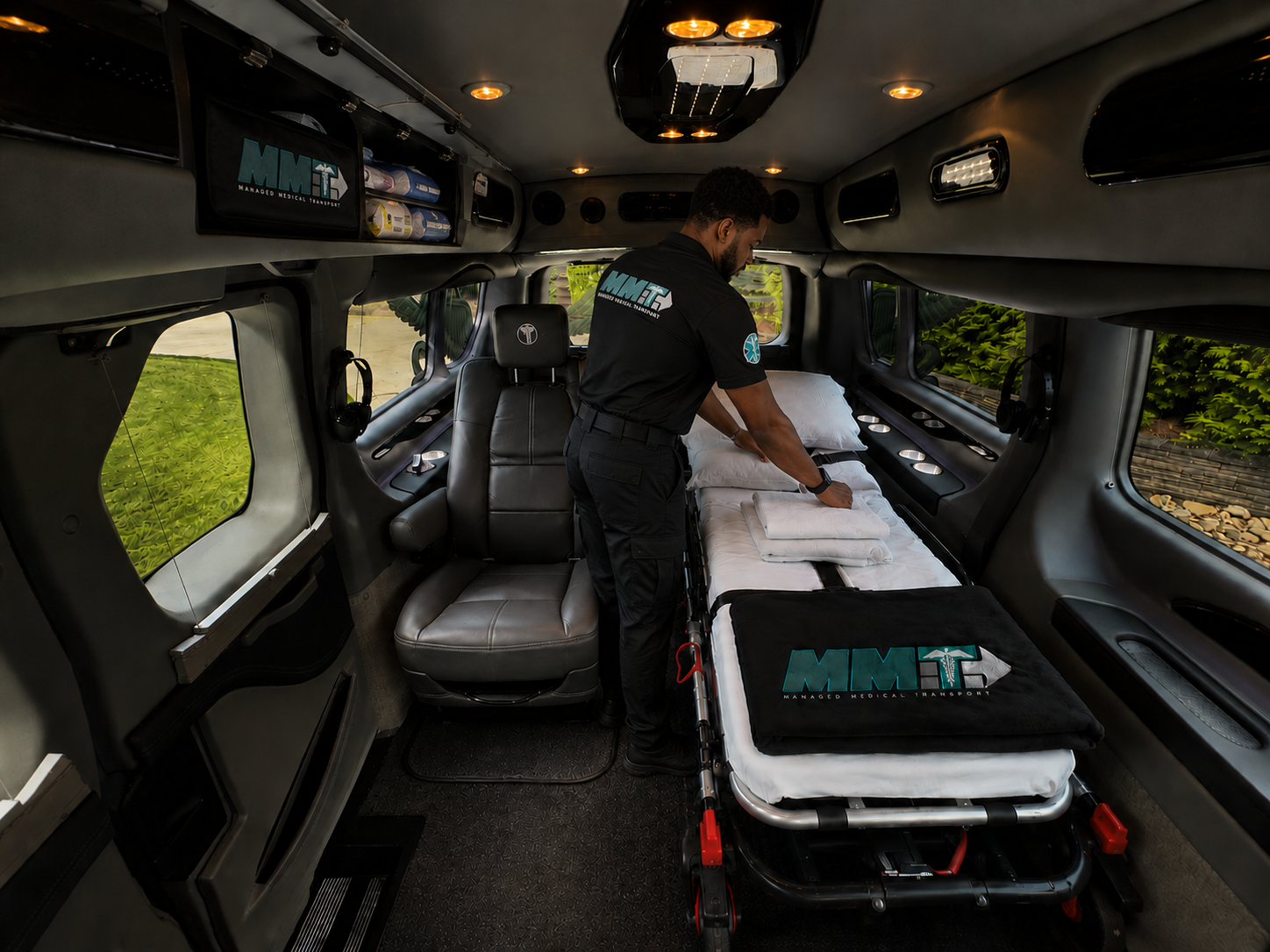
- Overlooking comfort needs for long distances: Bedding, repositioning expectations, and planned stops should be discussed before pickup.
Your Step-by-Step Plan for an Across-State Discharge Ride
Prerequisites (gather before you start):
- Discharge destination address and contact person (home, rehab, nursing facility, etc.)
- Estimated discharge window and unit/room details
- Patient mobility status (ambulatory, wheelchair, non-ambulatory)
- Current prescribed care plan details relevant to travel (medication timing, feeding schedule, oxygen use, swallow precautions)
- Insurance questions (if applicable) and preferred payment method
-
Confirm the discharge “ready time” and who can authorize release.
Tip: Ask the unit what “ready” means in practice (paperwork complete, meds reconciled, patient dressed, belongings packed) and who will call you when it’s truly go-time.
-
Identify the correct mobility level and vehicle needs.
Tip: If the patient is bed-bound or non-ambulatory, clarify whether a forward-facing stretcher setup is available for comfort on long trips.
-
Coordinate acceptance with the receiving facility or home caregiver.
Tip: Get a direct phone number for the receiving nurse’s station or intake coordinator and confirm the arrival window they can support.
-
Compile a travel-ready information packet.
Tip: Keep essentials in one folder: discharge summary, medication list, prescriptions, allergy list, ID/insurance cards, and key contacts. This reduces confusion during handoff.
-
Plan the care-continuity schedule for the trip.
Tip: Use the patient’s existing prescribed schedule as the anchor—then align departure time and planned stops so routines are realistic during travel.
-
Set expectations for comfort, stops, and communication.
Tip: Ask how updates are provided to family, whether real-time tracking is available, and how often repositioning can be supported if it’s part of the existing plan.
-
Do a final “door-to-door” walkthrough before pickup.
Tip: Confirm pickup entrance, parking/loading instructions, elevator access, and who will physically accompany the patient out of the unit.
When It’s Smart to Bring in a Transport Specialist
Consider professional help if any of the following are true:
- The patient is non-ambulatory, bed-bound, or needs a stretcher for travel.
- The trip is long-distance (hundreds of miles) and comfort/positioning will be a major factor.
- The patient has prescribed routines that must be maintained during travel (medications, feeding tubes, oxygen, diabetic care routines).
- The receiving facility has a narrow intake window and timing must be tightly coordinated.
- You need consistent communication to reduce family stress during a multi-hour or multi-day trip.
Your Questions, Answered
How far in advance should I start coordinating an out-of-state discharge ride?
As early as you can once discharge planning begins. Cross-state trips involve scheduling, confirming receiving acceptance, and assembling paperwork, so earlier coordination usually reduces last-minute friction.
What information does a transport provider typically need from the hospital?
Common items include the discharge window, pickup location details, mobility status, and the patient’s existing prescribed routines that must be maintained during travel (such as medication timing or oxygen use).
Can a family member ride along during the trip?
Some long-distance medical patient transportation services allow one family member to ride with the patient. Confirm seating availability and what to bring before the pickup.
Is this the same as an on-demand medical rideshare?
No. Cross-state medical patient transportation is typically scheduled, planned, and equipped for mobility and comfort needs that standard rideshare vehicles aren’t designed to support.
What happens if the discharge time changes?
Discharge timing changes are common. The best approach is to keep one primary coordinator in touch with both the unit and the transport team so pickup timing can be adjusted without confusion.
The Path Ahead
Across-state hospital discharge transportation works best when you treat it like a coordinated handoff—not just a ride. Confirm the discharge window, match the vehicle to mobility needs, align receiving acceptance, and keep the patient’s existing routines in view so the trip stays predictable. If you’re evaluating providers, make sure the service is clearly non-urgent, designed for long-distance medical patient transportation, and transparent about what’s included. If you’d like to discuss a specific situation, Managed Medical Transport, Inc. (MMT America) can explain how their non-emergency transportation process is typically coordinated for long trips.
Book Your Consultation
Schedule a free consultation with our experts.